Reviewed by Lorena Padureanu
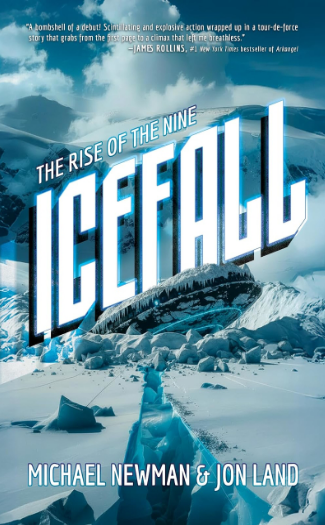
This book definitely deserves a screen adaptation. The detailed, vivid descriptions of every scene, landscape, and interaction quickly build an entire reality in the reader’s mind. From the frozen Alaskan wilderness to hidden underground facilities and alien worlds, the novel constantly creates a cinematic atmosphere. I could easily visualize every chapter unfolding like an episode, and the suspense kept me on the edge the entire time. Purchase Here.
The opening immediately immerses you in the heart of the story. Rather than easing readers in, the book begins with one of its most disturbing sequences: the Nine, extraordinary beings convicted of treason, are forced to witness the execution of their own families before having their identities erased and their memories stripped away. It’s a brutal prologue, but it gives the Nine emotional depth rather than presenting them as simple heroes or warriors.
The narrative then shifts to present-day Alaska, where state troopers Sakari Muhtuk and Tom Dennehy investigate what appears to be a routine call involving a stranded Amazon delivery driver. Their natural banter provides a welcome contrast to the darkness of the opening while gradually building tension as they uncover an abandoned town and a mystery that becomes increasingly unsettling. From there, the novel expands into something much larger: a story about alien civilizations, forgotten history, ancient technology, and humanity’s struggle for survival.
The action never loses momentum. The scenes kept me in a constant wave of chills and goosebumps from beginning to end while horrific alien creatures consumed people within seconds, and the characters desperately fought for survival across the frozen wilderness, as well as inside sterile, high-tech facilities. The pacing rarely lets up, yet it never feels exhausting because every action sequence pushes the story forward.
One of the book’s greatest strengths is its cast. In the middle of the novel’s most intense scenes, I found myself genuinely invested in every character. Each of them has a distinct personality that makes them easy to care about without the authors forcing emotional moments. They feel like real people rather than archetypes, and their relationships provide an emotional foundation that keeps the story grounded.
I appreciated how naturally the novel weaves together ideas that don’t initially seem compatible. Science, spirituality, love, human connection, and the supernatural all become parts of the same larger narrative. During the quieter moments between terrifying discoveries and battles, Sakari Muhtuk—an Inuit state trooper whose family has preserved strong shamanic traditions—shares stories passed down through generations about mysterious beings that once threatened her ancestors. Those stories constantly invite comparisons between Indigenous legends and the terrifying creatures the characters encounter. Later, when the Nine discover evidence in the Titan Base vault that extraterrestrial civilizations visited Earth long before recorded history, it’s difficult not to wonder whether many of humanity’s ancient myths were inspired by real encounters with alien beings that early civilizations simply had no way of understanding. What later generations remembered as evil spirits or monsters may have been something far more literal.
The book’s explanation for humanity’s origins is equally compelling, leaving you wondering whether there might be a kernel of truth behind its fictional premise. This revelation provides an intriguing framework that could explain many of our Earth’s long-standing mysteries.
Gaia, the representation of Mother Nature, appears in a way that is far more mysterious and powerful than expected. Rather than a symbolic force, Gaia becomes an almost godlike presence working through a young boy willing to sacrifice himself for the sake of humans. This extraordinary force rekindles hope, feeling like a divine intervention at humanity’s darkest moment.
The book blends science fiction, horror, mystery, mythology, and action without allowing any one element to overwhelm the others. Every revelation raises the stakes while naturally expanding the story’s scope.
Such a surprise was the conflict between the novel’s two artificial intelligences. Rather than treating AI as a simple tool, the story presents two machine intelligences with opposing philosophies and objectives, turning their confrontation into both a strategic battle and an ideological one. It complements one of the novel’s central themes: intelligence alone isn’t enough.
Ultimately, Icefall is a reminder that technology, robots, artificial intelligence, and even extraordinary abilities are not enough on their own. While AI and nanotechnology may possess immense power, humans are the heart that AI lacks and desperately needs for clarity and guidance. AI, as powerful as it may be, can lead to failure and destruction in the absence of emotional intelligence. In the end, humanity’s greatest strength isn’t its technology but the compassion, resilience, and emotional intelligence that no machine can replicate.