
Author Interview:
Anthony Lee

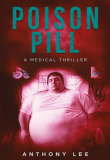
The books shown on the left are by Anthony Lee. Click on the cover to order.
Lily Andrews conducted this interview on January 27, 2026.
Lily: In this book, two seemingly unrelated cases converge into a single investigative arc. What drew you to a dual-case structure as the foundation of the plot?
Anthony: This novel was ultimately inspired by a specific lecture I had in medical school. A professor in my second-year pharmacology course briefly deviated from the usual lectures on various pharmaceutical drugs, by devoting one lecture to an overview of major herbal supplements. It mainly served to let medical students know what is out there in the world of complementary and alternative medicine (CAM), not to make them experts on natural medicines. It left an impression on me because, from that day forth, I became aware of not one but two parallel schools of medical thought: conventional medicine that championed pharmaceutical medications and CAM where herbal supplements are one major component. It also led me to see contrasting philosophies, with conventional medicine advocating evidence-based treatment and CAM being a proponent of natural therapies.
Medical thrillers of the past have tackled the pharmaceutical industry before. There could also be a book or two that centers on herbal supplements. But never has a medical thriller, as far as I know, portrayed both the pharmaceutical industry and the herbaceutical industry in the same story as parallel mirror images of medicine. Their differences, like with how government regulatory bodies treat them, keep the plotlines separate. But their similarities, like potential dangers to patients, are what can bring them together as two sides of the same coin. Consider this book to be something that comes full circle with that one pharmacology lecture I remember from medical school.
Lily: As I read through, I kept wondering, “what could have made you to structure corruption as a structural problem rather than an ideological one?” Maybe you could answer this here.
Anthony: When you say “ideological” and “structural,” I think about the nature of a medicine and its regulation.
With pharmaceuticals, drugs are essentially artificial, with regulatory measures to ensure that the active ingredient and dosage Is consistent from one pill to the next. That’s essentially the ideological core of pharma. However, side effects are to be expected, and if they are too problematic, company officials might downplay or hide them to get around tight regulations.
With herbal products, they are natural, which the lay public may perceive as being safe. That’s the ideological core of this type of medicine, which can be risky because natural products can have side effects too, especially as there are multiple ingredients at play, not one uniform active ingredient like with pharmaceuticals. As for the structural problem, the regulations for herbal products are much looser because they are treated like foods, not drugs, given their natural origin. That means you seldom see clinical trials of herbal supplements, just as you wouldn’t see that sort of thing with food products.
So when you look at both pharmaceuticals and herbaceuticals, both have inherent issues with the medicine itself and with the regulations overseeing them. Corruption stemming from any of these blind spots is bound to occur.
Lily: How intentional was your physiological construction of a protagonist who is not driven by heroism or ambition but by a deep compulsion to understand and to help?
Anthony: When I created Mark Lin, I knew that he should not be like any typical physician who is knowledgeable with medicine but also stays within the bounds of the profession. If something unusual happens in the hospital or a deeper dive into a case uncovers something bigger, I don’t want a doctor who just does nothing because of professional boundaries or personal fear. I want someone who will boldly go to great lengths to stop a problem at its source, even if it’s outside the hospital walls and there is risk involved. It’s either that or accept that a patient will suffer or die because there’s nobody else who can tackle the problem in a way that is within the scope of their job description. If anything, Mark feels that there is really nobody else but him to take on the problem.
Lily: At what stage of writing did the title (which comes out as a strong metaphor,) emerge? Also, how consciously did you build a symbolic meaning into it?
Anthony: Usually, I aim for titles that have a chilling ring to it while also having multiple meanings. Sometimes I can only come up with an original title for a thriller without being able to inject symbolic meaning. For Poison Pill, I just needed a title that simple while still conveying a sense of fear. The funny thing is that I intended the poison pill to be a literal one, without ever knowing beforehand that the term “poison pill” is a common term referring to something that makes a company unattractive to a hostile corporate takeover. Once I learned that, I suddenly smiled at the notion of that secondary meaning having some relevance to this story.
Lily: Did the plot emerge from thematic concerns about modern wellness economies or did it emerge organically from the medical narrative?
Anthony: This goes back to my understanding of pharmaceuticals and herbaceuticals, which is not just related to the medicines themselves and their regulations. I also have an eye on the distribution and marketing of these medications. Because the pharmaceutical industry is widely known for aggressive marketing tactics, I knew the pharma side of the novel’s plot had to center on this. I could then look at distribution for the herbal side. To keep both plot threads engaging, I had to make sure that they did not involve the same situations and observations. The more originality and less repetition, the better.
Lily: Are there any challenges you encountered when making abstract systems narrative feel threatening, like normal antagonists would?
Anthony: If you’re referring to portraying medical issues in a scary way, I would say the one challenge is deciding how to achieve that. The solution is simple: connect the medical details to something that laypeople would easily fear, like severe illness or death. Something like an abnormal lab test result may not frighten an ordinary reader because they may not know what it means. But if you explain what catastrophic consequences that could lead to, then you got something threatening for sure.
Lily: Do you see this book as a full blown thriller or as an eye-opener disguised as a thriller?
Anthony: I consider the book to be an eye-opening thriller. It’s like an equal mix of showing the reader the many nuances of the world of medicine and taking the reader on a rollercoaster ride of emotional turmoil. This is a balance I like. I don’t want a thriller that doesn’t really get deep into the nitty gritty of medicine, but neither do I want to write a novel where the majority is medical exposition and the thriller component is only a minor secondary element.
Lily: How would you describe your narrative style to readers encountering your work for the first time?
Anthony: I would describe my writing style as a blend of technical prose, poetic language, emotional intensity, and real-time narration. Because I write medical thrillers, I certainly have to use medical terminology for authenticity and realism. But I also know that writing it all like a medical textbook will not engage readers without any medical background. That’s where the poetic language comes in. I incorporate visual imagery, metaphors, and the like into those medical descriptions. The result is a technical poetic narrative that can appeal to anyone with or without a medical background. From there, I layer in prose that makes it clear what Mark is thinking and feeling, not just what he is doing. And by doing all of this, the narrative then becomes a step-by-step description of Mark’s mental state as he is navigating his environment, as if you are following his every moment in real time
Lily: What kind of reader did you have in mind when writing this book and what do you believe will make them connect deeply with the story?
Anthony: There are two kinds of readers: those who want quick popcorn reading and those who want stories with emotional depth. I consider myself in the latter category and, naturally, I write for those kinds of readers. My medical thrillers do have solid plots with twists and surprises, but I also layer in character depth by showing Mark Lin’s emotional state and his thoughts on what he is dealing with. And by also letting the reader know, with brutal honesty, how Mark feels about certain problems in the world at large, I add thematic depth. So if you like to read thrillers with depth that will make you think, my books are for you. If you seek just a quick read, popcorn thriller, or whatever, you can still read my books. Just know that there is more to my stories than just a plot that moves.
I also see that there are two kinds of protagonists: those whom the reader wants to like and those whom the reader wants to observe regardless of character likability. I consider myself in the latter category and so I write for those kinds of readers. I did not create Dr. Mark Lin as someone to feel good hanging out with like a friend. I created him as a complex character with a mix of strengths and flaws, so that readers can do their own psychological analysis about what makes him tick and why he does things a certain way, even if they would not be what the reader may normally do.
Lily: Lastly, after finishing “Poison Pill,” what do you believe will linger more with the reader? Is it the characters, the questions it raises, or the worldview that it challenges?
Anthony: Given my above comments about injecting character and thematic depth into my stories, I believe that any of those elements can linger with the reader. For Poison Pill specifically, readers might think twice about the risks of herbal supplements and pharmaceutical medications, among other things mentioned in the story. They may also come away with thoughts about certain characters, like the patients who have fallen victim to the two types of poison pills presented. It all depends on the reader. As long as they enjoy more than just the plot, I can be satisfied knowing that I have opened readers’ eyes, hearts, and minds.
Lily: Thanks for graciously agreeing to do this interview with me!