Reviewed by Douglas R. Cobb
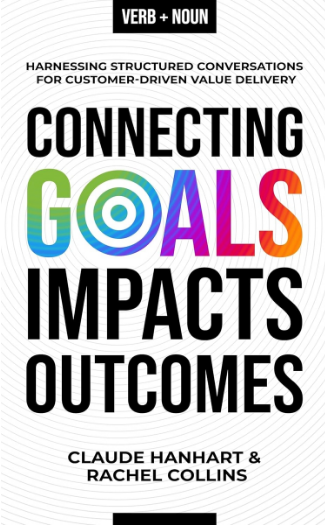
Anyone who runs a local or national business or is an executive in a product-driven industry will learn a lot of great techniques to ensure the success of their products after reading Connecting Goals to Impacts and Outcomes: Harnessing Structured Conversations for Customer-Driven Value Delivery by authors Claude Hanhart and Rachel Collins. These types of people appear to be the main target audience for this book, so the audience might seem relatively niche. Nevertheless, this book is one that its target audience will likely want to check out, and, as the title implies, it is crucial that a company’s goals be connected to the impacts and outcomes desired. Purchase Here.
The target audience also has knowledge of Agile planning sessions. What are those? Well, I didn’t know what they were until I read the book, but the authors mention that, though Agile sessions can be important, they “still struggle to create real customer and business value” for a company.
That quote comes from the Preface of Connecting Goals to Impacts and Outcomes. Also, they called the development of their ideas “an ambitious product effort.” They write that they were leading a project and “Despite everyone’s best intentions and genuine commitment,” a problem arose. The problem was, they continue, that they “realized the core issue wasn’t technical or strategic—it was conversational,” and that they “had no reliable way to ensure that when we talked about goals, requirements, or success, we were all talking about the same thing.”
So, the authors developed a fairly detailed way for everyone to get on the same page, and for everyone to have the same definitions for whatever sorts of “goals, requirements, or success.” Oh, yeah–and, of course, it’s also important that a company’s customers develop a long-term relationship with a company by having a favorable impression of it. As the authors write, certain broad goals, when it comes to customers, are often agreed upon, like a business should do what it can to “improve customer experience” or “increase engagement.”
But, businesses also need to have their customers interact with features about themselves and their products, and they need to impress their stockholders. The authors of Connecting Goals to Impacts and Outcomes do a much better job of explaining what their book is all about than I can, as I’ve barely touched the surface of the topics included, so here is what they write about the book:
This book shows product leaders, Agile coaches, and delivery teams how to use clear language and visual thinking to align strategy, product decisions, and day‑to‑day work around measurable outcomes.
In this book, you’ll learn how to:
- Write clear, outcome‑focused goals using VERB + NOUN syntax that eliminate ambiguity
- Connect customer needs to business impact using Empathy Mapping, Customer Journey Mapping, and Impact Mapping
- Align product roadmaps and delivery plans with OKRs that drive accountability and learning
- Validate assumptions early using Hypothesis‑Driven Development and Example Mapping
- Facilitate cross‑functional Agile conversations where disagreements become productive
- Turn vague requirements into clear, executable user stories that teams interpret the same way
Drawing on experience across startups, financial services, and large‑scale Agile transformations, Structured Conversations bridges the gap between product strategy and value delivery with techniques that work in real‑world environments.
This is all a process that can go on for several months, or, presumably, longer. But that seems to be all a part of the process of continuous improvement, something all companies strive for.
The way some companies utilize their Agile teams doesn’t always result in success. As the authors note, the various Agile teams involved can all be working hard, but the end result can be less than what had been hoped for. In such a scenario, when a project fails, despite the best efforts of everyone on the Agile teams, the authors write, “The gap isn’t execution. It’s how goals, assumptions, and decisions are discussed.”
I am but a simple book reviewer and an author of Westerns and a few other books, so I cannot at all make any claims about whatever is covered in Connecting Goals to Impacts and Outcomes, but I can write a few of my humble opinions about it. I’d say that success can be measured in many different ways. I’m not at all 100% certain, what definition of success is when it comes to potentially the projects of multiple companies with budgets of millions of dollars.
The techniques and strategies mentioned in this involved but entertaining read have made me realize that shared definitions for whatever is important to the individual companies can be crucial for the eventual degree of success experienced when it comes down to projects, goals, and companies. I don’t operate or own any company, but a lot of what the two authors of Connecting Goals to Impacts and Outcomes say makes sense. If this looks like something that you would like to check out, I am sure you will learn many tips and techniques to both “improve customer experience” and “increase engagement.” Check it out today!
Authors: Get Reviewed
Readers: Latest Reviews