Reviewed by Lily Andrews
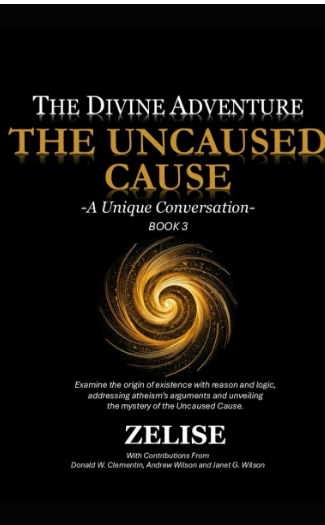
Zelise’s “The Divine Adventure—The Uncaused Cause” is an intellectually captivating third installment in her ‘Divine Adventure’ series. With thoughtful depth and curiosity, this book continues the series’ bold exploration into the origins of existence, inviting readers on a philosophical and spiritual journey that challenges the boundaries of what they think they know. Building on earlier discussions from the previous volumes, this installment focuses on a fundamental question: the existence of an “Uncaused Cause.” What’s unique here is that it opens up a real, respectful conversation between theism and atheism, exploring what both worldviews have to say about the origin and coherence of reality. Purchase Here.
In this book, Zelise engages Orion, an AI assistant, in a kind of Socratic dialogue that travels through a wide range of topics—from quantum physics and the limits of scientific explanation to the possibility that consciousness might have existed before time and space. The two land on a powerful observation: that both atheists and theists, accept that ‘something’ must have always existed, whether they call it God or a quantum field. With a keen and open mind, Zelise dives into the quantum vacuum, the Big Bang, and multiverse theory, and then gently raises the big question: do any of these theories actually remove the need for a
Creator? One of the strongest threads in the book is its profound exploration of consciousness and imagination. It effectively contends that the human capacity for creativity, love, dreaming, and decision-making may indicate something beyond the regular operation of the brain.
Much like in the earlier ‘Divine Adventure’ books, Zelise asks questions that go deeper than common theories and facts. She doesn’t hand out easy answers, but she does make a heartfelt and reasoned case for a divine origin—an eternal consciousness that sustains everything. Whether one agrees with her or not, they’ll probably find themselves turning these questions over long after they’ve finished the book.
What really makes this book stand out is the tone. It doesn’t try to win an argument—it invites the reader in for a real conversation. The author has taken big, abstract ideas and made them feel approachable. Clear analogies that provide the required depth, such as “a sea of energy boiling under the surface,” which vividly depict the quantum vacuum have been employed. Zelise is a refreshing voice in a time when science and spirituality are often seen as opposing forces. Many people today are either questioning their old belief systems or looking for something more meaningful than blind faith or rigid materialism. Zelise meets them right in that middle space—building a bridge between curiosity and meaning, where belief and reason don’t have to cancel each other out.
Her writing style is one of the book’s biggest strengths. It’s clear, down-to-earth, and never pretentious. She has explained deep, complex ideas without sounding like a textbook—and without oversimplifying anything. That kind of balance is rare. Her prose has a warm, steady rhythm, and one can feel that she genuinely cares about helping the reader understand, not just proving a point.
“The Divine Adventure: The Uncaused Cause” is perfect for thoughtful seekers—people who might be rethinking old beliefs, or who lean agnostic or atheistic but still feel drawn to the possibility of something deeper. It’s not a theology manual, and it’s definitely not about evangelizing. It’s a book for people who like big questions, who enjoy rich, respectful dialogue, and who aren’t afraid to sit with mystery for a while. Spiritually curious skeptics will find a lot to chew on here—without feeling preached at or pushed. It’s the kind of book that feels more like a long, meaningful conversation with a wise friend than a lecture. And in today’s world, that kind of voice feels especially needed.