Reviewed by Ephantus Gold
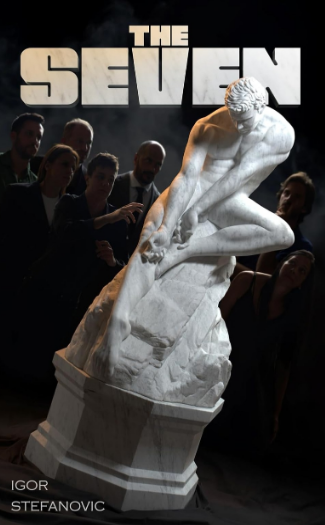
“The Seven” by Igor Stefanovic, a sweeping family saga, begins with the shocking decision by an aged father to send each of his children to different continents, with the intention of breaking them out of their insulated, privileged lives and having them learn what he couldn’t teach them himself. Abraham, an old man and patriarch of the Meyer dynasty, has never believed in privileges, but rather in hardship and struggle through which he has built an empire that includes Meyer Diamonds and International Hotels. The first pages show him as a regret-haunted man who sees happiness as a lie told to people to cover up the true nature of reality. He recently discovered that he has lung cancer, prompting him to summon his children and assign them to travel the world in search of seven sculptures that best portray the purity of love. However, only known to him, and to his friend and confidant, Obed, the task isn’t really about sculptures but about deeper, startling realities. Some of the children dismiss the request as an old man’s stubborn theatrics, while others see it as a distraction masking something secretive. None, however, surprisingly, has the guts to refuse out-rightly, especially after the old man warns of dire repercussions if any of them disobeys. Purchase Here.
What follows is a journey that severely fractures the family across continents, with each child thrust into a world that doesn’t feel in the least fit for them. Talk of Asia, Africa, Europe, etc.; these destinations embody everything they had never dreamed of or predicted, from isolation, to what feels like stillness that demands honesty, to people unimpressed by wealth, to power that refuses to submit, to the impossibility of having it all without having a loss, and to environments where systems fail and others that do not obey or follow rational timelines. These realities force them to confront the emotional gaps they have long avoided, as well as the adult version of those gaps they have produced. They also establish the conditions for a reckoning in which identity, responsibility, and love move beyond theory and are tested through loss and severe discomfort.
In this book, the reader is allowed into the characters’ definitions of love through each of their journeys, revealing how love has been translated into different substitutes, including control, achievement, and independence. The very inviting thrill of finding sculptures that best portray the purity of love feels like a mirror one beholds as they delve deeper into the story, one that will help the reader gauge how much they are willing to relinquish, endure, and leave behind in lasting form. By framing the concept of love through a quest for the right sculpture, it feels like the novel is trying to suggest something life-changing – that love may not actually need to be proven through intensity or intention as widely believed, but through that which survives time, pressure, and at times, personal costs.
This story’s primary focus feels ancient in nature from the first page, yet modern in texture, which I believe makes it relatable rather than merely abstract. It’s remarkable how its strongest qualities get revealed through characterization rather than explanation- basically, what the characters do when under pressure, and through a father figure who comes out as more of a moral engine than he is a moral authority. I believe that sending the characters all over the world signals a global psychological exploration of its core themes. Lastly, its episodic, character-driven chapters capture each sibling’s arc, while keeping the subject-object at the center across the arcs, which, as a result, keeps the narrative unified. “The Seven” by Igor Stefanovic is a must-read for readers who love a story without a major protagonist, as well as those who ask big “life” questions, particularly about success, direction, and values. It is also that story which, instead of offering closure, invites reflection, asking readers to carry these questions beyond the last page.