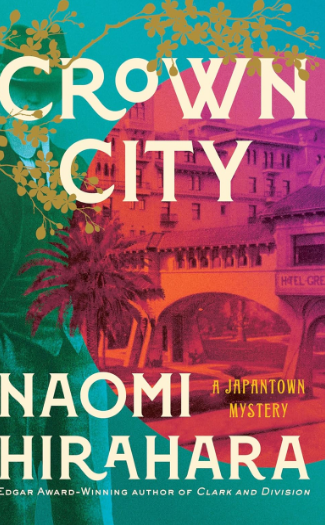
Reviewed by Ephantus Gold
In her new historical mystery novel, “Crown City: Book 3 of A Japantown Mystery,” Naomi Hirahara deftly expresses that feeling of being an outsider looking in. The novel seeks to answer the “who-am-I-here” dilemma through Ryunosuke “Ryui” Wada who we meet first not as a detective, but as a dreamer, who is eighteen years old and stumbling off a ship with a suitcase of dreams and a heart full of grief. Without parents, he wrestles with the implications of being an orphan in an often vicious world where his sanity and survival are threatened. Purchase Here.
Japan no longer has a place for young Ryui due to his young age and inexperience which would have allowed him the opportunity to run his father’s business. But he has developed an unassailable confidence, not weighed down by centuries of tradition thanks to his father’s trade connections with both Americans and Britons. He gazes out over the sea and travels to “Crown City,” Pasadena, California to reinvent himself hoping to one day return home as “the golden boy.” Initially, Pasadena appears to embody the ideals of wealth and progressive ideals and, for a moment, you want to believe that everything would go well for Ryui in his new occupation as an art dealer apprentice. Yet this trust is neatly dispelled by the author, who immediately establishes an unsettling quality that presents the warm welcome as fragile and, somehow, fast-fading.
The story begins with a one-two punch as Ryui is assaulted and then a painting by Toshio Aoki, one of the best-known Japanese artists in Pasadena, is taken from his studio. Instead of going to the police, Aoki enlists Ryui and Jack to conduct an under-the-table investigation. This decision exposes considerable discord in the community beyond the unsaid insistence to perpetuate the “perfect image” whilst dealing with private, and sometimes oppressive, matters.
Initially intrigued by the prospect of becoming a detective, Ryui emerges as a well-crafted protagonist. His decisions provide a crash course on the brutal realities of his new home just before all of the intricately woven fabric of his dream is almost pulled apart. The stolen painting is the first thread he pulls even as the question of whether he can beat the odds quickly become something that grows in ways that are both exhilarating and incredibly unsettling.
Hirahara has a very straightforward style, while maintaining the same cadence. She is impressive in how one minute she hits you with an unforgettable image or moment and the next one has you in the streets of Pasadena. You vividly find yourself beholding in your imagination Ryui and his unwavering optimism and tenderness, Jack and the mounds of quiet mystery, and even the flashes back to Yokohama, all trade and noise.
All of this convinces me that the book will engage two main readerships: readers who like drawing attention to significant matters of identity and belonging in an immigrant story, and those who want a well-written historical mystery with a moving backstory. The terrifying hypothesis that Ryui’s future is in fact the biggest mystery he must crack is what Hirahara leaves her readers with. What’s so powerful about “Crown City: Book 3 of A Japantown Mystery,” is that it’s not merely recreating the crime, but creating a culture where none existed. This book can be read as a standalone and that’s part of its strength.